-

-
Visit Us
Find Your Nearest Store
Visit Us
Find Your Nearest Store
Two phones can go into the same puddle and have completely different outcomes. Here's what actually separates the ones that recover from the ones that don't.
"Water damage" gets talked about like it's one event with one outcome, but it isn't. A phone splashed by rain and a phone dropped in a pool for a minute face very different odds — and so do two identical phones that had different things happen in the first 60 seconds after they went in.
At Case Indulgence, we see the full spectrum of water damage outcomes across our QLD and NSW stores, and the pattern is consistent enough to actually explain. This is what genuinely determines whether a phone recovers.
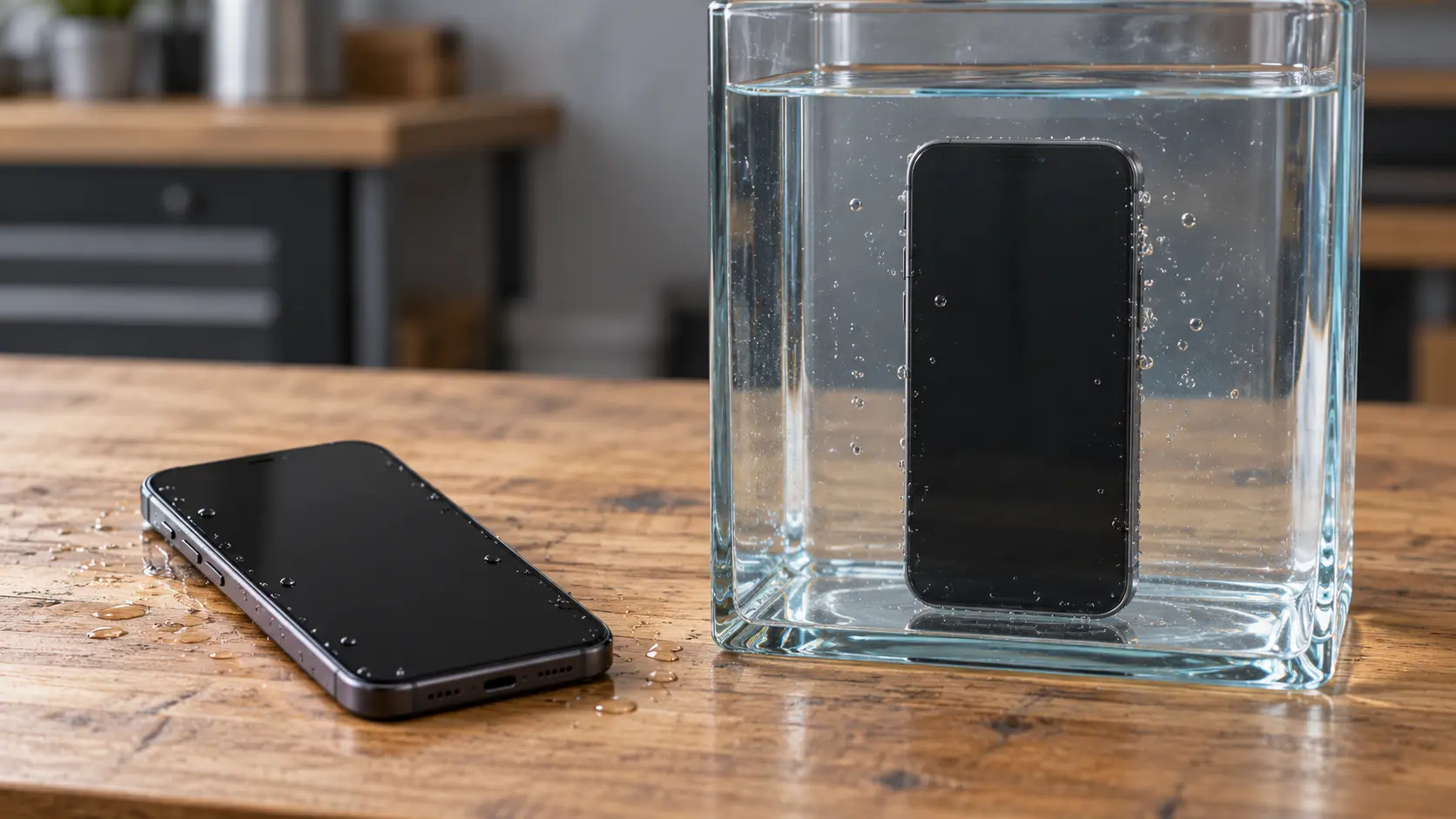
Ranked by how much each factor actually swings the outcome, based on what we see in practice.
This is the single biggest factor, and the only one entirely in your control. A phone that's powered down within the first minute has dramatically better odds than one left on, because most of the lasting damage comes from electrical current meeting moisture, not the moisture itself.
A quick splash and a two-minute submersion are not the same event, even in identical water. The longer liquid has to find its way past seals and into seams, the more components it reaches.
A current-generation phone with intact seals has a real advantage — but that rating was tested on a factory-fresh device under specific lab conditions. A two-year-old phone with a few drops behind it, or one that's had a screen replaced with the seals not perfectly reseated, has meaningfully worse real-world protection than its rating suggests.
Fresh water and rain are the most forgiving. Saltwater and sugary drinks are the least, because they leave behind conductive, corrosive residue that keeps causing damage long after the phone is dry.
IP68 ratings specify a maximum depth and duration — commonly around 1.5 to 2 metres for 30 minutes, though this varies by model. Beyond that depth or duration, the seal's tested protection no longer applies, even on a brand-new phone.
Every prior drop, every previous repair, and every year of thermal expansion and contraction slightly degrades the rubber seals that keep water out. An older phone is working with a smaller safety margin than the spec sheet implied on day one.
An IP68 rating means a phone was tested to survive water exposure under specific, controlled conditions when it left the factory. It's not a permanent guarantee, and it's not tested again once the phone is in your pocket for two years.
It's also worth knowing that manufacturer warranties typically exclude liquid damage entirely, water-resistance rating or not — both Apple and Samsung state this clearly in their Australian warranty terms. The rating buys you a real safety margin on a new device. It doesn't buy you immunity, and that margin shrinks over time.
| Scenario | Typical Outcome |
|---|---|
| Caught in rain, brief exposure | Very good — minimal risk on most modern phones |
| Splashed or spilled on, wiped immediately | Good — low risk if dried and not charged while wet |
| Dropped in a sink or toilet, retrieved in seconds | Good, provided it's powered off immediately |
| Brief pool dunk, a few seconds | Moderate — depends heavily on how fast it's powered off |
| Dropped in the ocean or a few seconds in saltwater | Moderate to poor — saltwater residue is the real risk, even after drying |
| Submerged for several minutes | Poor — meaningful risk of lasting internal damage regardless of rating |
| Washing machine cycle | Poor — combines submersion, agitation, and often heat from the dryer afterward |
As a general pattern rather than a guarantee for any specific model: current-generation flagship phones with an official IP68 rating and intact seals handle brief, accidental exposure noticeably better than older phones or budget models with no official water resistance rating at all.
That gap narrows a lot once you're talking about genuine submersion rather than a splash, and it narrows further on any phone that's had a prior screen or back glass replacement where the seals weren't properly restored — which is exactly why we take extra care with seal replacement on any repair involving a water-resistant model.
A phone can work immediately after a spill and still be in trouble. Watch for these over the following days:
Any one of these within the first couple of weeks points to corrosion already in progress, not a coincidence.
If it's just happened, the first 30 minutes matter more than almost anything else — we've covered exactly what to do (and what to avoid) in detail in our full guide to the first 30 minutes after water exposure. The short version: power it off immediately, don't charge it, skip the rice, and get it checked within 24–48 hours rather than waiting to see what happens.
No. It means the phone was tested to survive specific conditions when new, not that it's permanently waterproof. Seals degrade with age and prior damage, and manufacturer warranties typically exclude liquid damage regardless of rating.
Current-generation flagship phones with an official IP68 rating and undamaged seals generally handle brief accidental exposure best, though this advantage narrows significantly with genuine submersion or on an older device with worn seals.
Generally no, even with the same original IP rating. Seals wear down over years of use and prior drops, meaningfully reducing real-world protection compared to when the phone was new.
This varies by model and rating, but most official ratings cover roughly 30 minutes at a specified shallow depth. Beyond that, or beyond the rated depth, survival becomes considerably less likely.
Yes, significantly. Saltwater is highly conductive and corrosive, leaving behind residue that continues causing damage even after the phone appears dry, unlike fresh water exposure.
Not necessarily. A phone can work normally for days or weeks before corrosion-related faults appear, especially after saltwater or sugary liquid exposure. It's worth getting checked even if it seems fine.
Whether a specific phone will pull through isn't something you can tell just by watching how it behaves for a day or two. A free assessment checks the internal moisture sensors and actual condition, so you know where things genuinely stand.

Our skilled technicians are dedicated to restoring your devices to their optimal functionality.


© 2026 CaseIndulgence. All Rights Reserved